
The $675M Pre-Product Playbook: How Figure AI Built a Narrative So Compelling It Drew Investments from OpenAI and Jeff Bezos
Inside the fundraising strategy that turned a humanoid robotics startup into a $2.6B company before product launch.

When a robotics startup raises $675M at $2.6B valuation before proving unit economics, you’re not just looking at exceptional fundraising… you’re seeing the blueprint for narrative-driven deep tech investing.
The Billion-Dollar Bet Before Product-Market Fit
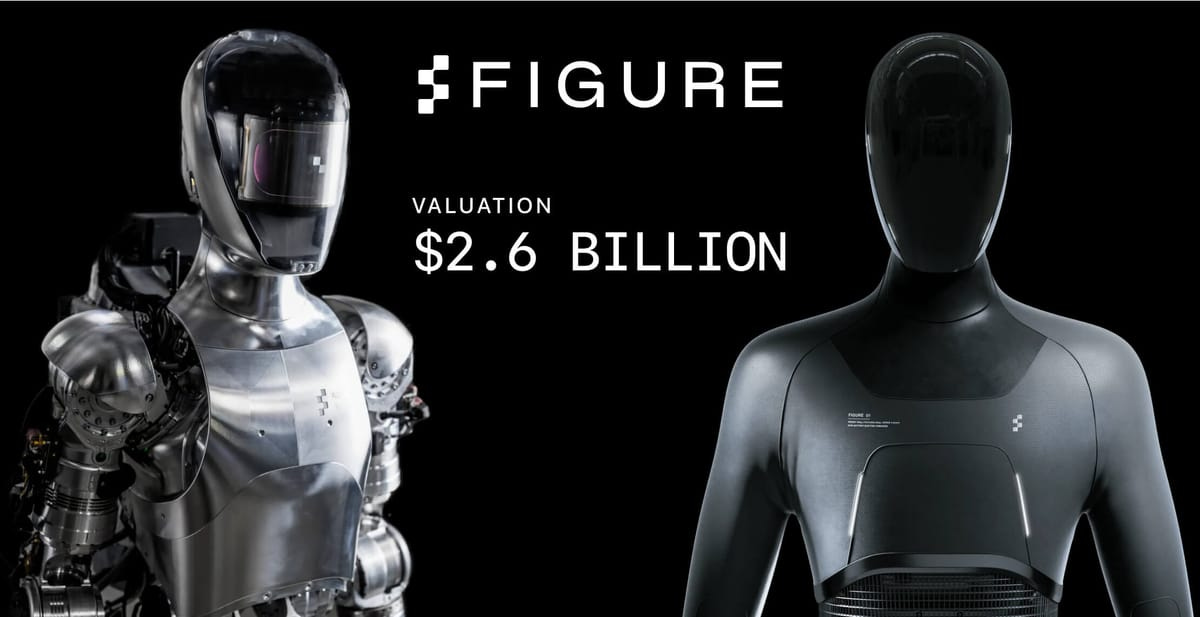
February 29, 2024. A two-year-old robotics company achieved something that rewrote venture capital playbooks: Figure AI closed a $675 million Series B at a $2.6 billion valuation with backing from Microsoft, OpenAI Startup Fund, NVIDIA, Jeff Bezos through Bezos Expeditions, and Intel Capital.
This wasn’t capital deployment. This was validation of a thesis that humanoid robotics had crossed from science fiction to industrial necessity.
What makes this remarkable isn’t the dollar amount… it’s the timing! Figure secured this valuation before commercial deployment at scale, before proving unit economics, and before demonstrating sustained product-market fit. For deep tech founders navigating the notorious valley between lab success and market reality, Figure’s pre-product playbook offers a masterclass in narrative construction that convinced the world’s most sophisticated technology investors to bet on potential rather than performance.
The stakes extend beyond a single company. The global robotics market projects $218 billion by 2030, with humanoid robots representing the fastest-growing segment. Yet historical data shows 90% of robotics startups fail to scale beyond pilot programs. Figure’s approach reveals critical patterns for navigating what kills most deep tech ventures: the gap between technical capability and commercial viability.
The Unlikely Revolutionary Behind the Vision
Brett Adcock represents everything traditional robotics leadership isn’t. Born on a third-generation Illinois farm in 1986, his journey to humanoid robotics bypassed the usual academic credentials from MIT, Stanford, or Carnegie Mellon. Instead, his path reveals a pattern of serial entrepreneurship across software, transportation, and now robotics.
Starting at 16, Adcock launched multiple ventures as a “dead broke” solopreneur. By 2013, he founded Vettery, a talent marketplace that achieved a $100+ million exit to Adecco. In 2018, he pivoted to Archer Aviation, building electric vertical takeoff aircraft that went public at a $2.7 billion SPAC valuation.
This non-traditional background became Figure’s strategic advantage. While robotics PhDs pursued technical elegance and incremental improvements, Adcock understood market mechanics, capital formation, and narrative construction from his software and aviation ventures.
His insight for Figure emerged from watching AI advance exponentially in digital domains while physical-world applications remained constrained by hardware limitations. The founding thesis: “giving legs to AI”; literally embodying artificial intelligence in humanoid form.
Unlike academic robotics labs pursuing decades-long research trajectories, Figure approached robotics with a startup mindset: rapid iteration, customer validation, and scalable business models. This distinction would prove critical for investor attraction.
The Convergence Thesis That Changed Everything
Figure’s founding hypothesis addressed a unique convergence creating unprecedented market opportunity:
Labor Shortage Crisis: Advanced economies face structural workforce gaps. U.S. manufacturing alone reports 2.1 million unfilled positions, with aging demographics accelerating this trend. Traditional automation (fixed robotic arms, conveyor systems) cannot address flexibility requirements in human-centric environments.
AI Capability Inflection: Large language models demonstrated AI could understand, reason, and execute complex instructions through natural language. The breakthrough question: could this intelligence be embodied in physical form for real-world tasks? The timing was critical: AI had reached sufficient sophistication to enable learned behaviors rather than programmed responses.
Hardware Readiness Threshold: Advances in actuators, sensors, battery technology, and edge computing had reached economic viability for humanoid robotics. Unlike previous generations constrained by power consumption and processing limitations, current technology enabled sustained industrial operation.
Figure’s architectural insight: “We’ve designed our world for the human form. Hands allow us to open doors and use tools; arms and legs allow us to move efficiently, climb stairs, lift boxes.” Rather than redesigning environments for robots (the traditional approach) they would build robots navigating existing human infrastructure.
This represented a fundamental shift from special-purpose automation to general-purpose robotics, targeting the $160 billion market for human labor in structured environments.
Product Strategy: Engineering Reality from Vision
Figure’s development strategy deliberately inverted traditional robotics timelines. Instead of perfecting prototypes in controlled laboratories for years, they prioritized rapid iteration in real-world deployment scenarios.
Foundation Architecture (2022-2023) Figure recruited talent from Boston Dynamics, Tesla Autopilot, and leading institutions. Their breakthrough was Figure-01: a 5’6” humanoid weighing 130 pounds, walking at 1.2 mph with 5-hour battery life. The robot featured 16 degrees of freedom, enabling human-like movement patterns.
Critical technical decisions prioritized robustness over elegance. Figure-01 was designed for industrial environments, not demonstration videos. The architecture emphasized modular components, enabling rapid iteration on individual subsystems without complete redesigns.
AI Integration Revolution (2023-2024) The transformative innovation came through AI integration. Rather than traditional programmed robotics, Figure developed learned behaviors through their OpenAI collaboration to “develop next generation AI models for humanoid robots” and utilize Microsoft’s Azure infrastructure for AI training and storage.
This partnership enabled Figure robots to understand natural language instructions, adapt to new tasks without reprogramming, and improve performance through experience. The technical breakthrough was bridging the gap between AI reasoning and physical manipulation, a challenge constraining robotics for decades.
Commercial Validation (2024-Present) Figure 02 features integrated cabling, torso-mounted battery with 50% greater capacity than Figure 01, addressing primary industrial deployment constraints. Six RGB cameras paired with onboard vision language models, plus human-scale hands and perception AI trained with synthetic data enable high-precision pick-and-place tasks for smart manufacturing.
The technical progression reveals Figure’s strategy: each generation targeted specific deployment bottlenecks rather than pursuing incremental improvements across all specifications.
The Narrative-First Capital Strategy
Figure’s funding trajectory demonstrates how narrative construction preceded and enabled product development:
Series A Foundation (2022-2023): Initial rounds funded by traditional robotics and enterprise software investors based on team credentials, technical vision, and early prototypes. Total funding approached $100 million across multiple tranches.
Series B Breakthrough (February 2024): The $675 million round at $2.6 billion valuation represented a quantum leap. The investor composition reveals Figure’s narrative strategy; rather than robotics specialists, they attracted AI infrastructure players (Microsoft, NVIDIA), AI research leaders (OpenAI), and visionary technologists (Bezos).
Jeff Bezos’ participation through Bezos Expeditions follows his $1 billion Agility Robotics investment, suggesting a portfolio approach to humanoid automation. The progression from traditional robotics investors to AI ecosystem leaders illustrates Figure’s successful positioning at technology convergence points.
Post-Series B Trajectory: Recent reports suggest Figure is raising additional capital at a $39.5 billion valuation, though this requires verification given private market volatility. The potential progression from $2.6 billion to $39.5 billion in under twelve months illustrates both investor conviction and speculative nature of pre-revenue robotics valuations.
Commercial Reality: The BMW Partnership Test
Figure’s BMW partnership at Spartanburg, South Carolina manufacturing plant illustrates both promise and complexity of humanoid robotics commercialization. Announced January 2024, the partnership positioned Figure-01 robots to “learn new skills on the assembly line” and handle “repetitive or dangerous jobs to improve productivity and safety.”
Deployment Constraints: Initial applications remain limited to specific tasks rather than general-purpose deployment. Robots operate in controlled environments with predetermined workflows, highlighting gaps between demonstration capabilities and industrial flexibility requirements.
Economic Validation Challenge: Cost-benefit analysis for humanoid robots versus traditional automation remains unproven in most applications. Customers require clear ROI metrics (typically 18-24 month payback periods) before large-scale adoption. Figure’s robots currently cost approximately $200,000 per unit, competing against established automation solutions with proven economics.
Technical Performance Gaps: Despite advances, current humanoid robots require structured environments and predefined task parameters. The transition from impressive demonstration videos to consistent 24/7 industrial performance represents ongoing engineering challenges.
Customer Adoption Cycles: Industrial customers maintain conservative timelines, often requiring 2-3 years from pilot programs to full deployment. This timeline mismatch with venture capital expectations creates execution pressure.
Strategic Pivots That Redefined Success
Partnership-Accelerated Development Rather than pursuing perfectionism in isolation, Figure strategically partnered with customers (BMW) and technology providers (OpenAI, Microsoft) to accelerate development and validation. This approach provided real-world testing environments while demonstrating customer traction to investors.
AI-First Architecture Decision The OpenAI collaboration represented a fundamental choice: building robots that learn rather than robots that are programmed. This positioned Figure at the intersection of AI revolution and robotics evolution, expanding their addressable investor base beyond traditional robotics specialists.
Market Education Over Market Entry Figure invested heavily in public demonstrations, media presence, and industry education about humanoid robotics capabilities. This strategy built market demand before attempting large-scale sales, reversing traditional robotics go-to-market approaches.
Interdisciplinary Talent Strategy Figure recruited across software engineering, AI research, mechanical engineering, and manufacturing rather than concentrating on traditional robotics expertise. This interdisciplinary approach enabled innovation at technology convergence points.
Execution Gaps and Learning Opportunities
Overpromise Risk: Public statements about deployment timelines and capabilities occasionally outpaced technical reality. While effective for building investor confidence, this created credibility risks when deployment progress lagged public expectations.
Technical Debt Accumulation: Rapid iteration and demonstration focus may have created technical debt complicating long-term scalability. Pressure to maintain investor confidence can incentivize shortcuts that later constrain product trajectories.
Market Timing Miscalculation: While AI capabilities reached inflection points, industrial adoption cycles remained conservative. The gap between technological possibility and market readiness created execution risks only apparent during customer pilots.
Competitive Response Underestimation: Figure’s success attracted significant competitive response from Boston Dynamics, Tesla, and new entrants. The market leadership window may have been narrower than initially estimated.
The Figure Playbook for Deep Tech Founders
Narrative Architecture Precedes Product Architecture Figure succeeded by constructing a compelling future vision that attracted partners, talent, and capital before establishing product-market fit. Their narrative became self-fulfilling by attracting resources necessary to achieve the vision.
Tactical Application: Develop investor materials positioning your startup at technology convergence points rather than within traditional industry boundaries. Figure positioned as AI+Robotics+Labor rather than pure robotics.
Convergence Positioning Strategy Rather than competing as pure robotics, Figure positioned at the intersection of artificial intelligence, robotics, and labor automation. This expanded their addressable investor base and reduced comparison to traditional robotics companies with slower growth trajectories.
Tactical Application: Identify 2-3 technology trends converging around your solution. Build investor narrative around convergence timing rather than incremental improvements within existing categories.
Strategic Partnership Acceleration BMW and OpenAI partnerships provided customer validation and technical capability simultaneously, accelerating development while reducing perceived execution risk.
Tactical Application: Prioritize partnerships providing both technical capabilities and customer validation. Structure partnerships to generate reference customers, not just development resources.
Talent Density Over Geographic Concentration Figure recruited from multiple domains and locations rather than concentrating in traditional robotics centers, creating interdisciplinary innovation advantages.
Do This, Not That Framework
DO: Build narrative attracting strategic investors who contribute capabilities beyond capital DON’T: Pursue traditional sector-specific funding from robotics investors exclusively
DO: Demonstrate progress through customer partnerships rather than laboratory achievements
DON’T: Perfect technology in isolation without continuous market feedback
DO: Position at technology convergence points rather than within established categories DON’T: Compete solely on technical specifications versus incumbent solutions
DO: Recruit interdisciplinary teams spanning software, hardware, and business development DON’T: Hire exclusively from traditional robotics academic backgrounds
Investor Pattern Recognition
Founder Profile Analysis: Successful robotics companies increasingly led by serial entrepreneurs with cross-domain experience rather than pure academic researchers. Market understanding and narrative construction capabilities often outweigh technical depth for scaling ventures.
Convergence Timing Evaluation: Robotics investments require careful analysis of technology convergence timing. Figure succeeded because AI capabilities, hardware readiness, and economic necessity aligned simultaneously.
Partnership Strategy Assessment: Robotics companies securing strategic customers and technology partners significantly de-risk execution while accelerating development cycles. Evaluate partnership quality, not quantity.
Capital Efficiency Metrics: Despite large funding rounds, successful robotics companies demonstrate measurable progress through customer partnerships rather than purely internal milestones. Focus on external validation metrics rather than technical specifications.
The Academy-to-Industry Translation Blueprint
Figure AI’s success represents more than exceptional fundraising—it demonstrates how narrative construction can bridge the notorious valley of death between academic robotics research and industrial application.
Traditional robotics companies emerged from university labs with technical sophistication but struggled with market translation, customer acquisition, and business model development. Figure inverted this model, beginning with market understanding and building technical capability to match commercial requirements.
This approach reflects a broader industry shift where competitive advantage increasingly derives from market positioning, partnership formation, and execution speed rather than purely technical differentiation.
For founders transitioning from academia to industry, Figure’s playbook offers a replicable template: build the compelling story that attracts resources to make the story reality. In an industry where the gap between laboratory success and commercial deployment has historically proven insurmountable, Figure demonstrated that strategic narrative construction, when backed by competent execution, can become self-fulfilling prophecy.
The Ultimate Test
Figure’s technical roadmap requires solving fundamental challenges in AI reasoning, mechanical reliability, and economic viability. But their approach to building investor conviction before product conviction provides a framework for robotics founders navigating the transition from research to revenue.
The robotics revolution may not be led by the most technically sophisticated companies, but by those that best understand how to translate technical possibility into market reality. Figure AI’s pre-product playbook (narrative first, partnerships second, product third) offers the blueprint for this translation.
For the broader industry, Figure’s success signals maturation where robotics ventures can attract mainstream technology capital rather than relying solely on specialized investors. This capital access transformation may prove as significant as any technical breakthrough in accelerating the industry’s transition from academic research to commercial deployment.
The Question for Founders: Can you build a narrative compelling enough to make the future you’re building inevitable?
Case Study Analysis: Figure AI represents the new paradigm where deep tech success depends as much on narrative construction as technical capability. Their playbook [positioning at convergence points, securing strategic partnerships, and building market demand before market entry] provides a replicable framework for founders navigating the valley between lab success and commercial reality.